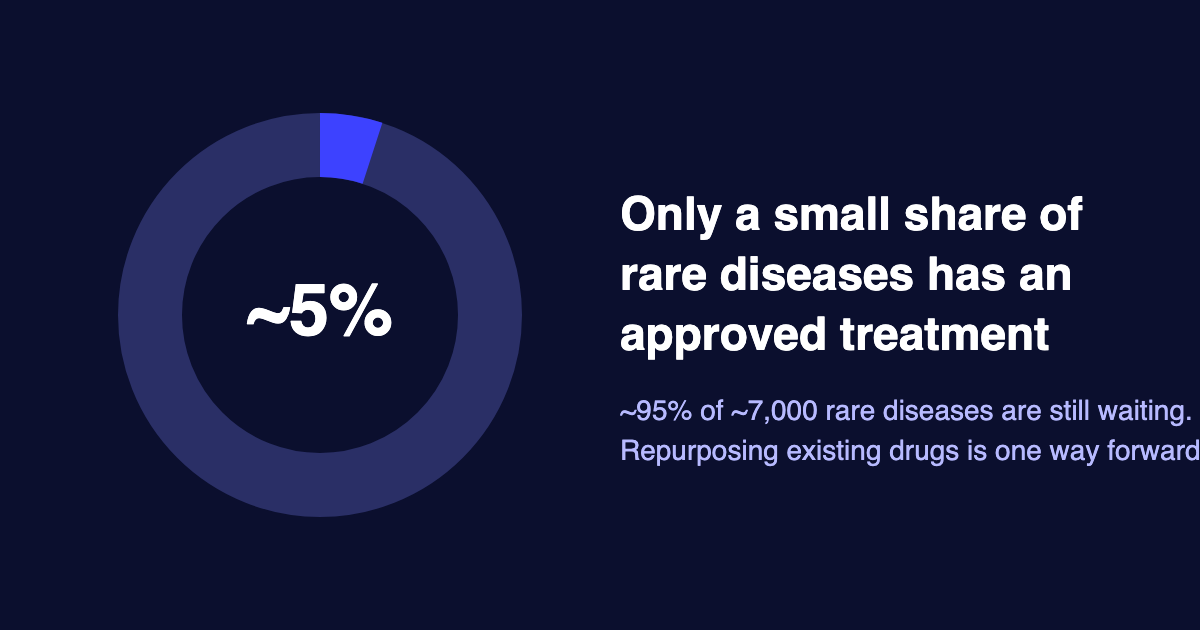
Developing a new drug from discovery to approval typically takes a decade or more and costs enormous sums. For a rare disease with a few hundred patients, the economics often do not work. Drug repurposing offers another route: find a new use for a medicine that is already approved.
Why repurposing is attractive
An approved drug already has safety data, known dosing and an established manufacturing process. If it also shows promise for a different condition, researchers can often skip early development stages. That can mean faster timelines and lower costs, a real advantage when the patient population is small.
Famous examples
Repurposing is not a new idea. Sildenafil was first studied for heart conditions and later became a treatment for erectile dysfunction and, at a different dose, pulmonary arterial hypertension. Thalidomide, withdrawn for its tragic effects in pregnancy, was later approved under strict controls for certain conditions including multiple myeloma.
The challenge: finding the match
Most repurposing discoveries happened by accident or through observation. There are thousands of approved drugs and thousands of rare diseases, so the number of possible pairings is huge. Testing them one by one is impossible.
How AI changes the search
Machine learning can compare a disease’s genetic and molecular profile with what is known about how drugs act in the body, then rank candidate matches for researchers to investigate. It does not replace clinical trials. It helps decide which ideas deserve a trial in the first place.
That is the focus of RareGeno’s platform: a low-cost way for researchers and drug developers to screen existing medicines against rare disease data.