Rare disease research has always faced the same constraint: not enough patients, not enough data and not enough funding in one place. Artificial intelligence does not remove those limits, but it gives small teams more leverage.
Where AI is useful today
- Genomic interpretation. Models help prioritize which genetic variants in a patient’s genome are likely to cause disease.
- Phenotype matching. Algorithms compare a patient’s clinical features against known conditions to suggest possible diagnoses.
- Literature and data mining. Language models can surface relevant studies and connect findings across fields.
- Drug-disease matching. AI can rank existing compounds that may act on a disease’s underlying biology, supporting repurposing efforts.
What AI cannot do
AI predictions are hypotheses, not proof. They depend on the quality and diversity of the training data, and rare disease data is sparse and often biased toward better-studied populations. Every promising result still needs laboratory validation and clinical trials.
Why data agnostic design matters
Real research data arrives in many formats: electronic health records, genetic test reports, wearables, trial datasets. Tools that can work across these sources, rather than demanding a single format, are far easier for organizations to adopt.
Privacy first
Patient trust is essential. Working with anonymized data, and giving partners control over how their data is used, is the foundation of responsible AI in this field.
The benefits of working with RareGeno
RareGeno was built around the constraints rare disease teams actually face: small budgets, scattered data and the need to work with many partners. Here is what that means in practice.
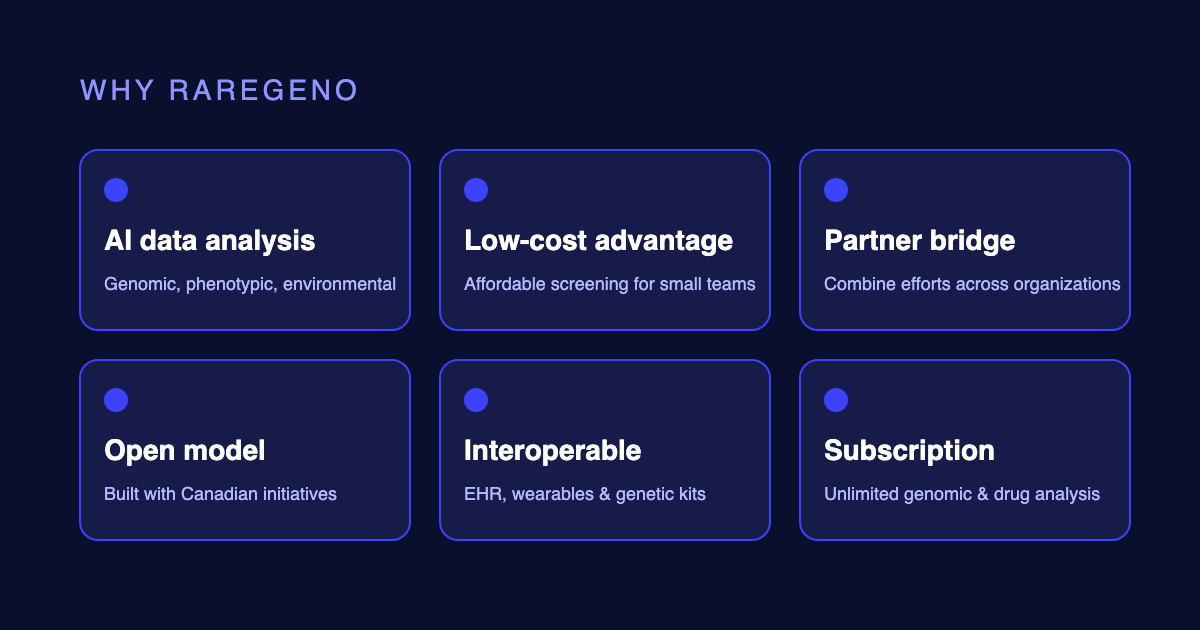
- AI data analysis. We analyze genomic, phenotypic and environmental data from clinical trials to reach unmatched accuracy.
- Low-cost advantage. Organizations researching rare diseases or alternate uses for existing drugs can screen candidates without building their own infrastructure.
- Partner bridge. The platform lets private organizations and companies centralize and combine efforts to access more insightful data.
- Open model. We work closely with local and government initiatives in Canada so that insights can improve rare disease treatment options.
- Interoperability. Our data-agnostic approach combines data from EHR systems, wearables and genetic kits.
- Subscription access. One subscription provides unlimited usage of genomic testing, biobanking and data analysis of existing drugs.
Try our free research tool and see how RareGeno can support your next study.